Demo & Benchmarks
LatticeZero includes a built-in demo system powered by the DEKOIS2 benchmark suite. Run real molecular scoring experiments directly in your browser to evaluate platform performance and learn the tools.
The DEKOIS2 Benchmark
DEKOIS2 (Demanding Evaluation Kits for Objective In Silico Screening) is a widely-used benchmark suite for evaluating molecular docking and scoring methods. Each target includes:
- Known active ligands - experimentally confirmed binders
- Matched decoys - non-binders designed to have similar physicochemical properties to actives
- Pre-docked poses - 3D coordinates for all ligands in the binding site
The challenge: can the scoring function distinguish actives from decoys?
Running the Demo
- Navigate to Try Demo in the sidebar (or go to
/demo/run) - Browse available targets - each shows the target name, protein class, and number of ligands
- Click a target to select it
- Choose Score Mode (IsoScore) or Dock Mode (IsoPose)
- Click Run - scoring begins immediately in your browser
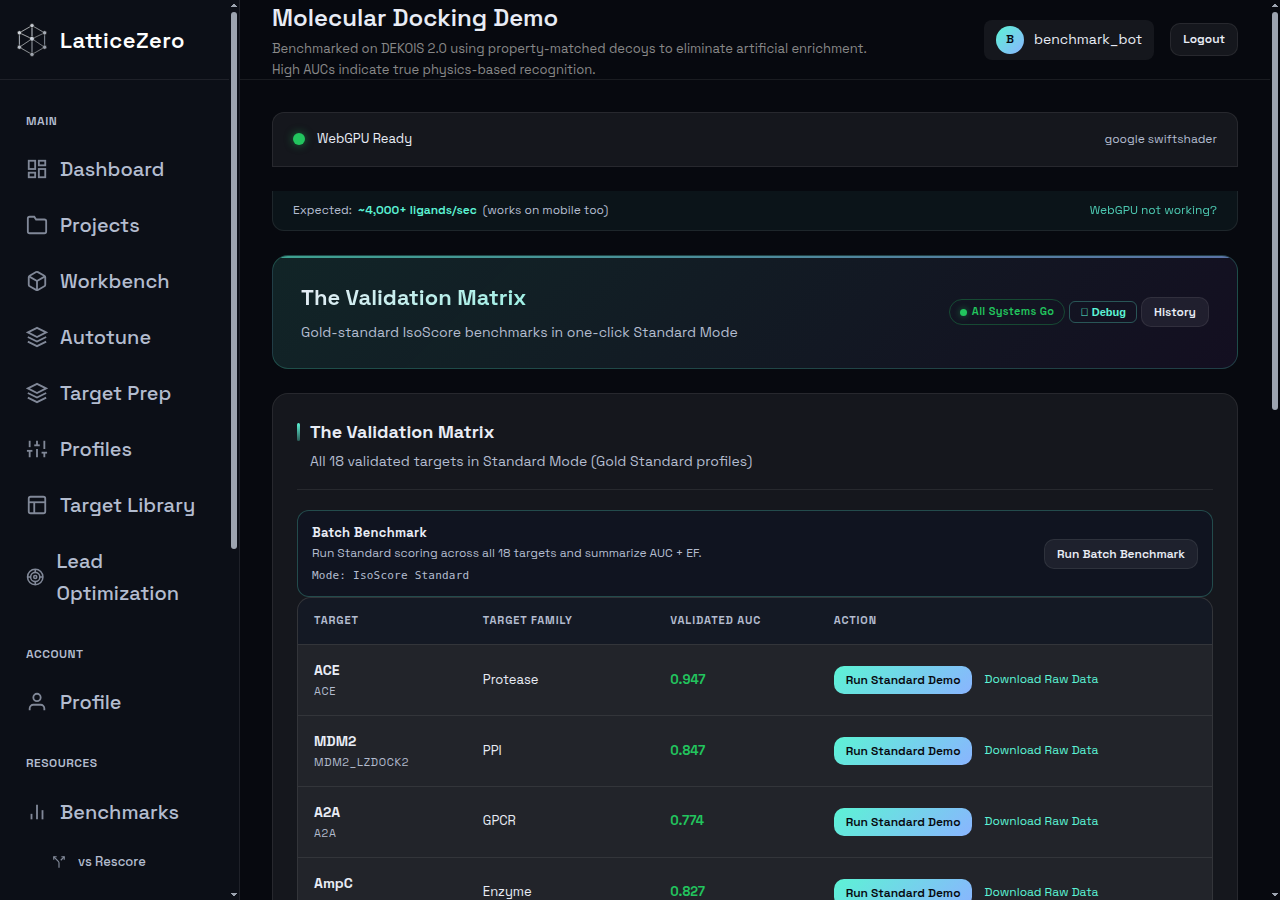 Demo target selection with protein cards
Score Mode (IsoScore)
Rescores all pre-docked poses at ~4,000 ligands/sec. Best for:
- Quick evaluation of scoring accuracy
- Comparing different scoring profiles
- Large target datasets
Dock Mode (IsoPose)
Performs full docking at ~3 sec/ligand. Best for:
- Evaluating pose prediction quality
- Testing on individual targets
- Comparing docked vs. pre-docked poses
Available Demo Targets
The demo includes validated DEKOIS2 targets spanning multiple protein classes:
| Target | Protein | Class | Ligands | Mode |
|---|---|---|---|---|
| ACE | Angiotensin-converting enzyme | Metalloprotease | 40A + 1200D | Score & Dock |
| EGFR | Epidermal growth factor receptor | Kinase | 542A + 27420D | Score & Dock |
| CDK2 | Cyclin-dependent kinase 2 | Kinase | 219A + 6570D | Score & Dock |
| HSP90 | Heat shock protein 90 | Chaperone | 88A + 2640D | Score & Dock |
| MDM2 | Mouse double minute 2 | PPI | 78A + 2340D | Score & Dock |
| P38a | p38 MAP kinase alpha | Kinase | 137A + 4110D | Score & Dock |
| UROK | Urokinase | Serine protease | 55A + 1650D | Score |
| FXa | Factor Xa | Serine protease | 146A + 4380D | Score |
| ESR1 | Estrogen receptor alpha | Nuclear receptor | 135A + 4050D | Score |
| AMPC | AmpC beta-lactamase | Hydrolase | 48A + 1440D | Score |
| PDE5 | Phosphodiesterase 5 | Phosphodiesterase | 74A + 2220D | Score |
| GBA | Glucocerebrosidase | Hydrolase | 52A + 1560D | Score |
A = Actives, D = Decoys
Understanding Results
After scoring, the demo produces:
ROC Curve
The Receiver Operating Characteristic curve plots the true positive rate (sensitivity) against the false positive rate (1 - specificity) at every score threshold.
- AUC = 1.0 - perfect discrimination (all actives scored above all decoys)
- AUC = 0.5 - random (no better than coin flip)
- AUC > 0.8 - strong performance suitable for virtual screening
 ROC curve with AUC value displayed
Enrichment Metrics
| Metric | Description |
|---|---|
| AUC | Area under the ROC curve (0-1) |
| EF1% | Enrichment factor at 1% of ranked list |
| EF5% | Enrichment factor at 5% of ranked list |
| BEDROC | Boltzmann-Enhanced Discrimination of ROC |
Score Distribution
A histogram showing the score distributions for actives vs. decoys. Good separation = good discrimination.
Validated Results
LatticeZero has been validated across the DEKOIS2 benchmark suite. Results with optimized profiles:
| Target | Default AUC | Optimized AUC | Tier |
|---|---|---|---|
| ACE | 0.82 | 0.95 | Platinum |
| HIVRT | 0.51 | 0.94 | Platinum |
| PPARG | 0.71 | 0.93 | Platinum |
| HMGR | 0.72 | 0.97 | Platinum |
| CATL | 0.70 | 0.85 | Gold |
| SRC | 0.55 | 0.71 | Silver |
Note: Optimized results use the Optimizer with target-class-specific priors. Default AUC uses the standard equal-weight profile.
Using Demo Results
The demo is useful for:
- Evaluating the platform - See real performance before committing to a project
- Learning the tools - Practice with validated data where you know the answer
- Profile comparison - Test different scoring profiles against known benchmarks
- Conference presentations - Run live demos with reproducible results
Next Steps
- LZ Packs - Download pre-validated target bundles for your own analysis
- Scoring Profiles - Understand how profile selection affects results
- Optimizer - Tune scoring weights for your specific targets